Rerate Watch

PLAB Rerate: Cyclical Washout or Structural Entry?

Theme: AI Infrastructure Buildout · Photomasks & Lithography · Semiconductor Supply Chain · Testing & Validation
Sector: Semiconductor & Advanced Materials

There’s a layer in the semiconductor supply chain that doesn’t show up in AI infrastructure pitch decks or CHIPS Act press releases, but nothing gets built without it. Every chip design — every NVIDIA GPU, every Apple A-series, every Marvell networking ASIC — requires a photomask before a single wafer gets etched. A photomask is a high-precision quartz plate containing the microscopic image of the circuit. It’s the master stencil. No mask, no chip.

Photronics makes those stencils. It holds roughly 63% of the global merchant photomask market, competes primarily against two Japanese conglomerates (Dai Nippon Printing and Toppan), and is the only U.S.-headquartered pure-play in the space. The stock just got cut nearly in half — from $56 to ~$30 — after a soft Q2 print. The market treated it like a broken cyclical.

That reaction makes sense if Photronics is what the market thinks it is. It makes much less sense if the company is becoming something else.

The market currently files Photronics in the cyclical semiconductor supplier drawer.

The label isn’t wrong on its face. Photomask demand moves with semiconductor design activity, which moves with industry capex cycles. When fabs are busy running existing designs, new mask orders slow down. When memory supply is constrained and customers delay new tape-outs, Photronics’ very short backlog (1–3 weeks of visibility) means revenue softens quickly.

The old story also carries a “boring” discount. Photronics doesn’t sell GPUs. It doesn’t build AI models. It doesn’t have a cloud platform. It makes glass plates in clean rooms. The company has ~1,900 employees, $861 million in trailing revenue, and no sell-side coverage beyond two analysts. It looks like a mature, low-growth, cyclically exposed components business — and the market prices it accordingly.

At ~$30, PLAB trades at roughly 11–13x trailing earnings (depending on data provider and EPS basis). That’s the multiple of a company the market expects to grow slowly, if at all, and to remain at the mercy of semiconductor cycle timing.

The possible reclassification: mission-critical advanced semiconductor manufacturing infrastructure.

This isn’t a subtle distinction. It changes the comp set, the multiple framework, and the investor base.

Three structural forces are converging on the photomask layer in a way that may permanently change the business profile:

Chip complexity is compounding mask demand. As semiconductor designs move to smaller nodes, the number of photomask layers per chip increases, the precision requirements tighten, and the cost per mask rises. Advanced EUV masks at leading-edge nodes can cost $300,000–$500,000 each. Every generation of AI accelerators, advanced packaging (2.5D, 3D ICs), and heterogeneous integration drives incremental mask demand at higher ASPs. This isn’t cyclical. It’s structural — tied to physics, not capex budgets.

Semiconductor regionalization is creating new geographic demand centers. TSMC Arizona. Intel Ohio. Samsung Taylor. Micron New York. Every new fab being built on U.S. soil under CHIPS Act incentives needs a domestic photomask supply chain. Captive mask shops at foundries handle their own leading-edge production, but the expanding universe of advanced-node designs increasingly pushes overflow volume to merchant suppliers. Photronics is the only U.S.-headquartered merchant option.

Captive-to-merchant outsourcing is a secular trend, not a cyclical one. Running an in-house photomask operation is expensive and operationally complex. As chip complexity rises and the number of design starts proliferates across more customers and more nodes, the economics of maintaining captive mask capacity get worse. Foundries are increasingly outsourcing mainstream and high-end mask production to merchant suppliers — and that trend favors the company with the largest global merchant footprint and the most diversified node capability.

If any two of these three forces sustain, Photronics stops being a cyclical supplier and starts being something closer to Entegris or FormFactor — a specialized, hard-to-replace enabler sitting at a chokepoint in advanced semiconductor manufacturing. The market has not started asking that question.
Two things shifted the setup, and they happened simultaneously.

The first is the $330 million capex cycle. Photronics is executing the largest capacity expansion in its 57-year history, building advanced-node photomask production across two new geographies at once. The Allen, Texas facility is designed to be the primary U.S. merchant photomask hub — it starts delivering qualification masks this quarter (Q3 FY2026), with mainstream-to-high-end IC work transferring from Boise so that Boise can push deeper into sub-7-nanometer nodes. The Korea facility is adding 8-nanometer capability and below, with clean room preparation underway and initial revenue expected by end of FY2027. A new FPD mask writer in Korea targets G8.6 AMOLED applications at higher ASPs and enters full production later this year.

This isn’t maintenance capex. It’s a deliberate repositioning up the value chain and into new geographic demand centers — timed to coincide with the largest wave of U.S. semiconductor investment in history.

The second is the demand shock that obscured it. Q2 FY2026 landed soft: $210 million revenue (flat year-over-year, down 6.7% sequentially), with IC revenue declining 5% as foundry customers delayed design releases due to elevated fab utilization and memory supply constraints. Q3 guidance of $207–215 million confirmed the trough isn’t over yet. The stock lost 36% in a day.

The market saw a cyclical miss and priced in cyclical risk. What it may have missed is that the trough is masking a structural upgrade. Photronics is absorbing the cost phase of a capex cycle — $330 million in FY2026 spending — while simultaneously sitting in a demand air pocket. The cost is visible. The revenue from the new capacity is not, because it starts in FY2027. That’s the gap the rerate thesis lives in.

Metric Q2 FY2026 Q1 FY2026 Q2 FY2025
Total Revenue $210M $225M $210M
IC Revenue $148M $166M $156M
FPD Revenue $62M $59M $55M
Gross Margin 31% 35% 34%
Operating Margin 20% 26% 26%
GAAP Diluted EPS $0.54 $0.74 $0.40
Non-GAAP Diluted EPS $0.42 $0.59
Operating Cash Flow $47M $97M


Valuation snapshot (as of June 9, 2026):

Metric PLAB
Stock Price ~$29.56
Market Cap ~$1.7–1.8B
Trailing P/E ~11–13x (varies by data provider / EPS basis)
TTM Revenue ~$861M
Cash & Short-Term Investments $637.7M (includes $477.3M held in 50.01%-owned JVs)
Total Debt De minimis (~$3.9M)
FY2026 Capex Guidance $330M
52-Week Range $17.57 – $56.00
Revenue Mix IC 72% / FPD 28%
Node Mix High-End 52% / Mainstream 48%
Geographic Mix Taiwan 32%, Korea 19%, U.S. 18%, China 27%, Europe 4%

Q3 FY2026 Guidance: Revenue $207–215M, operating margin 18–20%, non-GAAP EPS $0.39–$0.45.

The new story is not yet proven. But several proof points are starting to surface.

The product mix is shifting toward high-end. High-end photomasks now represent 52% of revenue, up from a lower base in prior years. The Boise facility is already qualified at the 7-nanometer node and working on more advanced geometries. Management stated on the Q2 call that the Allen and Korea expansions will shift the revenue mix further toward advanced nodes carrying higher ASPs over FY2027–2028.

FPD is quietly becoming a differentiation story. Display revenue hit $62 million in Q2, up 13% year-over-year — one of the strongest quarters in company history for the segment. The new Korea mask writer specifically targets G8.6 AMOLED masks, which are larger, more complex, and carry meaningfully higher ASPs than standard display masks. This positions Photronics in the premium tier of display manufacturing as the industry shifts toward larger OLED substrates.

The Allen facility is on schedule. Qualification masks start this quarter. Management confirmed on the Q2 call that equipment installation is proceeding as planned, and they expect the U.S. to deliver the largest percentage revenue increase of any geography in FY2027. This is the key proof point to watch — if Allen converts on time, it validates both the capex thesis and the regionalization positioning.

The balance sheet is self-funding. Effectively debt-free (de minimis ~$3.9M in total borrowings). $637.7 million in cash and short-term investments — though $477.3 million of that sits inside 50.01%-owned JV entities, which limits near-term accessibility. Even so, Photronics is funding the entire $330 million capex cycle from cash on hand and operating cash flow — no dilution, no meaningful leverage. H1 FY2026 generated $144 million in operating cash flow despite the demand trough. This is a company investing at the peak of its spending cycle while maintaining a fortress balance sheet.

Strategic customer engagement is deepening. Photronics disclosed a joint development relationship with Samsung (for Tesla’s AI6 chips), collaborations with IMEC (the leading semiconductor research consortium), and partnerships with critical suppliers. These aren’t the relationships of a commodity supplier — they’re the relationships of an embedded manufacturing partner.

The classification mismatch is most visible in the comp set.

The market currently prices Photronics alongside cyclical semiconductor equipment and component suppliers — names that trade at 8–15x earnings, carry significant debt, and have limited pricing power. At roughly 11–13x trailing, PLAB fits that drawer.

But consider the companies that occupy the “mission-critical semiconductor infrastructure” drawer:

Company Trailing P/E. Forward P/E. Debt Role
Entegris (ENTG) ~75x ~34x $3.8B Specialty materials & contamination control
FormFactor (FORM) ~52x ~26x Minimal Probe cards & test infrastructure
Photronics (PLAB) ~11–13x De minimis Photomasks — the master stencil for every chip

These are all companies that sit at structural chokepoints in semiconductor manufacturing. They all have limited competition. They all benefit from rising chip complexity. The difference is that Entegris and FormFactor have already been reclassified by the market as essential semiconductor infrastructure. Photronics has not.

The question is whether that gap is justified or whether it reflects an outdated classification. PLAB has higher gross margins than Entegris (31% vs. ENTG’s cyclically compressed margins), effectively zero debt versus Entegris’ $3.8 billion, and a dominant 63% share of the global merchant photomask market. It doesn’t need the same multiple as Entegris to rerate. It needs the market to stop treating it like a commodity components supplier and start treating it like what it appears to be: a specialized, mission-critical enabler with structural demand tailwinds and a clean balance sheet.

Even a partial reclassification — from 11–13x earnings to 18–22x — would imply significant upside from current levels. And that range would still represent a steep discount to the semiconductor infrastructure comp set.

The old story might be right.

Photomasks may remain a cyclical business regardless of structural tailwinds. If fab utilization stays elevated, design releases stay delayed, and memory supply constraints persist through the back half of calendar 2026, the revenue trough extends. At 1–3 weeks of backlog visibility, Photronics has no ability to see it coming. Two more soft quarters and the market will conclude the cycle thesis was correct all along — and the stock has further to fall from $30.

China exposure is a real vulnerability. Roughly 27% of revenue comes from China (15% IC, 12% FPD), including through joint ventures where Photronics holds a 50.01% stake. Critically, $477.3 million of the $637.7 million cash balance sits inside those JV entities. Any escalation in U.S.-China semiconductor restrictions could impair a quarter of the business and strand nearly three-quarters of the balance sheet liquidity. This risk is not theoretical — it’s directionally consistent with the current policy trajectory.

The Allen ramp could disappoint. New facility ramps in semiconductor manufacturing are notoriously unpredictable. Customer qualifications take time. Demand needs to materialize in the right node at the right geography at the right moment. If Allen’s revenue contribution in FY2027 comes in below expectations — or if the margin impact of new depreciation compresses profitability before revenue scales — the investment thesis loses its near-term catalyst.

Insider selling was heavy ahead of the crash. $15.7 million in insider sales over the three months leading into a 36% stock drop is poor optics at best. Multiple securities law firms have opened investigations. While these are likely ambulance-chaser filings with no material liability, the insider selling pattern itself suggests management may have had more visibility into the demand softness than the market did.

The captive-to-merchant outsourcing trend is not guaranteed to accelerate. If leading foundries decide to invest in their own mask capacity rather than outsourcing — particularly for advanced nodes with national security implications — the secular tailwind weakens. TSMC, Intel, and Samsung all have the resources to keep mask production in-house if they choose to.

A stock doesn’t rerate because you’re right. The market needs a mechanism to change the multiple. For PLAB, these are the specific triggers:

Two clean earnings prints showing Allen revenue contribution. The single most important catalyst. If Q4 FY2026 and Q1 FY2027 show U.S. revenue acceleration driven by Allen, it proves the capex cycle is converting. The market currently has no evidence that the $330 million investment produces returns. Allen qualification masks this quarter, followed by revenue recognition, provides that evidence.

IC revenue recovery plus mix shift toward high-end. The cyclical bear case dies the moment IC revenue re-accelerates while high-end as a percentage of mix continues climbing. That combination signals both cyclical recovery and structural upgrade — and it’s the data that forces a comp set re-evaluation.

New analyst coverage. Photronics has two analysts. Two. For a $1.8 billion company with 63% global merchant market share in a mission-critical semiconductor input. A coverage initiation from a semiconductor-focused or mid-cap-focused research desk — particularly one that frames PLAB as semiconductor infrastructure rather than cyclical supply — could catalyze the reclassification directly.

Guide raise. Management guides conservatively (1–3 weeks of backlog). A Q3 or Q4 guide raise — even a modest one — would signal demand inflection and likely trigger estimate revisions across the two existing coverage desks.

Margin recovery above 25% operating margin. Q2 operating margin compressed to 20% from 26% in Q1 on lower revenue and investment-phase costs. If margins recover toward 25%+ as Allen ramps and the product mix shifts higher, it changes the profitability narrative from “compressing” to “expanding through a cycle” — which is an infrastructure stock characteristic, not a cyclical one.

Capital return initiation. Photronics has never paid a dividend. With effectively zero debt, $637.7 million in cash (even adjusting for JV-held balances), and improving free cash flow generation, a buyback authorization or dividend initiation would signal management confidence in through-cycle cash generation — and attract a different class of institutional investor.

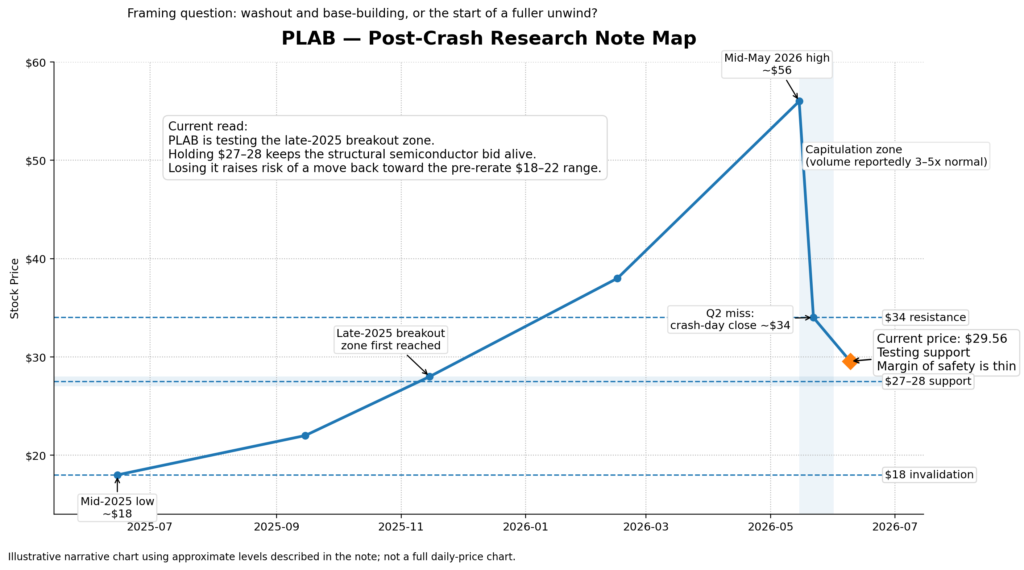
The chart matters here because it frames whether the post-crash move is a breakdown or a washout.

PLAB price map showing a rally from $18 to $56, a crash to $34, and a current test near $29.56 above key $27–28 support.

PLAB traded at $18 as recently as mid-2025, ran to $56 by mid-May 2026, then crashed to $34 on the Q2 miss and has since drifted to ~$30. The stock has now round-tripped to levels it first reached in late 2025 — erasing the entire AI/semiconductor enthusiasm bid but sitting well above the 2025 lows.

Volume on the sell-off was 3–5x normal. That kind of capitulation often marks a washout — forced selling by momentum holders who bought the run and bailed on the miss. The question is whether the stock bases here and builds a new floor, or whether it drifts lower toward the $18–22 range it traded at before the market started pricing in any semiconductor infrastructure premium.

Key levels: $27–28 (2025 breakout zone — if this holds as support, it suggests the structural bid hasn’t completely unwound), $34 (crash-day close — overhead resistance from trapped buyers), $18 (prior cycle low — the level that invalidates the rerate thesis entirely).

PLAB belongs on Rerate Watch not because the thesis is proven, but because the market may be applying a cyclical supplier label to a company that is structurally repositioning into the advanced semiconductor manufacturing layer.

The old story — cyclical photomask vendor, tied to display weakness and semiconductor capex timing — explains the current 11–13x multiple. The new story — mission-critical manufacturing bottleneck with 63% global merchant share, effectively zero debt, dual-geography capacity expansion, and the only U.S.-headquartered pure-play in a reshoring world — explains why the multiple might be wrong.

The gap between those two stories is the rerate opportunity. The Allen facility ramp is the proof point. FY2027 is the timeline. And the distance between PLAB’s current multiple and its potential comp set is the measure of what the market would pay if it changed the classification.

What would make us upgrade: Two quarters of Allen-driven U.S. revenue growth, IC segment recovery, and operating margins returning above 25%.

What would make us remove: Continued IC revenue deterioration through FY2027, Allen ramp delays, or material China-related impairment to JV assets.

For now: Watch the Q3 FY2026 print on August 26. Allen qualification masks are the leading indicator. If they convert, the rerate thesis gets its first real evidence.

UA Angle

PLAB is not the AI chip winner. It is the manufacturing layer beneath all of them. The market is treating Photronics like a cyclical supplier whose revenue softened at the wrong point in the cycle. But if photomask complexity, geographic semiconductor reshoring, and merchant outsourcing become more structurally valuable than the market currently believes, the boring supplier sitting at ~11–13x earnings with effectively zero debt and dominant 63% merchant share may deserve a very different classification. That is the rerate opportunity: not that PLAB suddenly becomes a high-growth AI stock, but that the market stops treating it like a commodity cyclical.

Disclosure

Upstream Alpha does not hold a position in $PLAB. Nothing on this site is financial advice. All content is for informational and educational purposes. Do your own research.